
Cognition, natural or machine-based, brings the proper answer to the challenge of successfully dealing with complexity.
Cognition opens the world of imaginary, for the service of reality, values, and collective behavior. It is central to life, and thus points at four key notions:
- Good
- Beautiful
- True
- Together
Cognitics is the domain of sciences, techniques and arts of automated cognition.
From now on – let’s say as early as 2023 – the general public uses the acronym “A.I.” to refer to cognitics; in this case, although the concept of “intelligence”, in itself, is a matter of the imaginary, now the term is also used by extension to describe the entire artificial cognitive system, including the real, machine-based infrastructure that is needed to underpin this automated intelligence.
At the same time, many specialists take a similar approach, even explicitly adding specific qualifiers such as “generative AI ” or “agentive AI,” and thus extend beyond cognition to also cover the realm of action in the real world and, implicitly, perception and the values that determine priority objectives, within a largely open, networked, and often collective context.
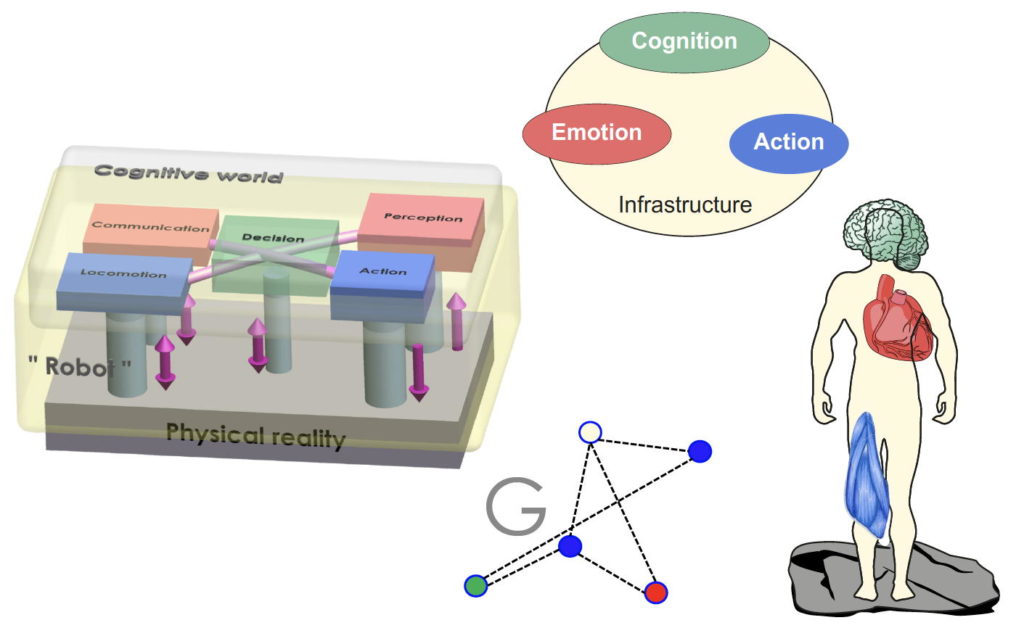
A similar figure, and other documents, can be downloaded, in French or English versions, from the given website (www.roboptics.ch/publications-jdd-plus).
Let us note from the outset that intelligence is defined here in a rigorous, measurable way—and ultimately one that is also very easy to grasp and understand—that is, in an axiomatic manner; intelligence is the capacity to learn, and more precisely, it is useful to view it here as cognitive acceleration, measurable in units of lin per second squared. Intelligence is a property of cognition and can manifest only within the framework of an integrated system, referred to here as a cognitive agent. Cognition can be schematically viewed as a world comprising two continents: rationality on one side and intuition on the other.
In contrast, the most prominent researchers in “artificial intelligence” refuse to acknowledge that cognition is always constrained, “trapped” between an infinitely complex reality and values that are necessarily very specific—much like a horse ready to gallop across vast plains, yet which, in its former utilitarian role, wore a harness and was guided by reins, a bit, and blinders. They dream of a “general” “intelligence,” which they define in vague terms. They have always looked down on computer science and continue to hold this attitude toward AI in the common sense. On the other hand, practitioners of AI in the common sense have achieved success, but with their “deep” neural learning techniques, they reduce intelligence to the realm of intuition; rationality is a necessary complement that computer science—in its traditional, ever-more-powerful evolution—continues to provide without the recognition it deserves, provided that the systems are completely autonomous… For when deep learning techniques are at work, humans are often still called upon within the decision-making loop to provide the necessary contributions in rational and ethical terms.
Particular reference:
Jean-Daniel Dessimoz, « Cognition and Cognitics – Definitions and Metrics for Cognitive Sciences, in Humans, and for Thinking Machines, 2nd edition, augmented, with considerations of life, through the prism “real – imaginary – values – collective”, and some bubbles of wisdom for our time », Roboptics Editions llc, Cheseaux-Noreaz, Switzerland, 345 pp, March 2020.
This site has not (yet?) included all the interesting information previously available. For additional content, please refer to our classic websites still in service: cognitics.org, cognitique.populus.org .
(FAQ: In addition, over 100 answers are available on the French Quora site: https://fr.quora.com/profile/JDD ).